
Single Origin · Ratnagiri Estate, Chikmagalur, Karnataka
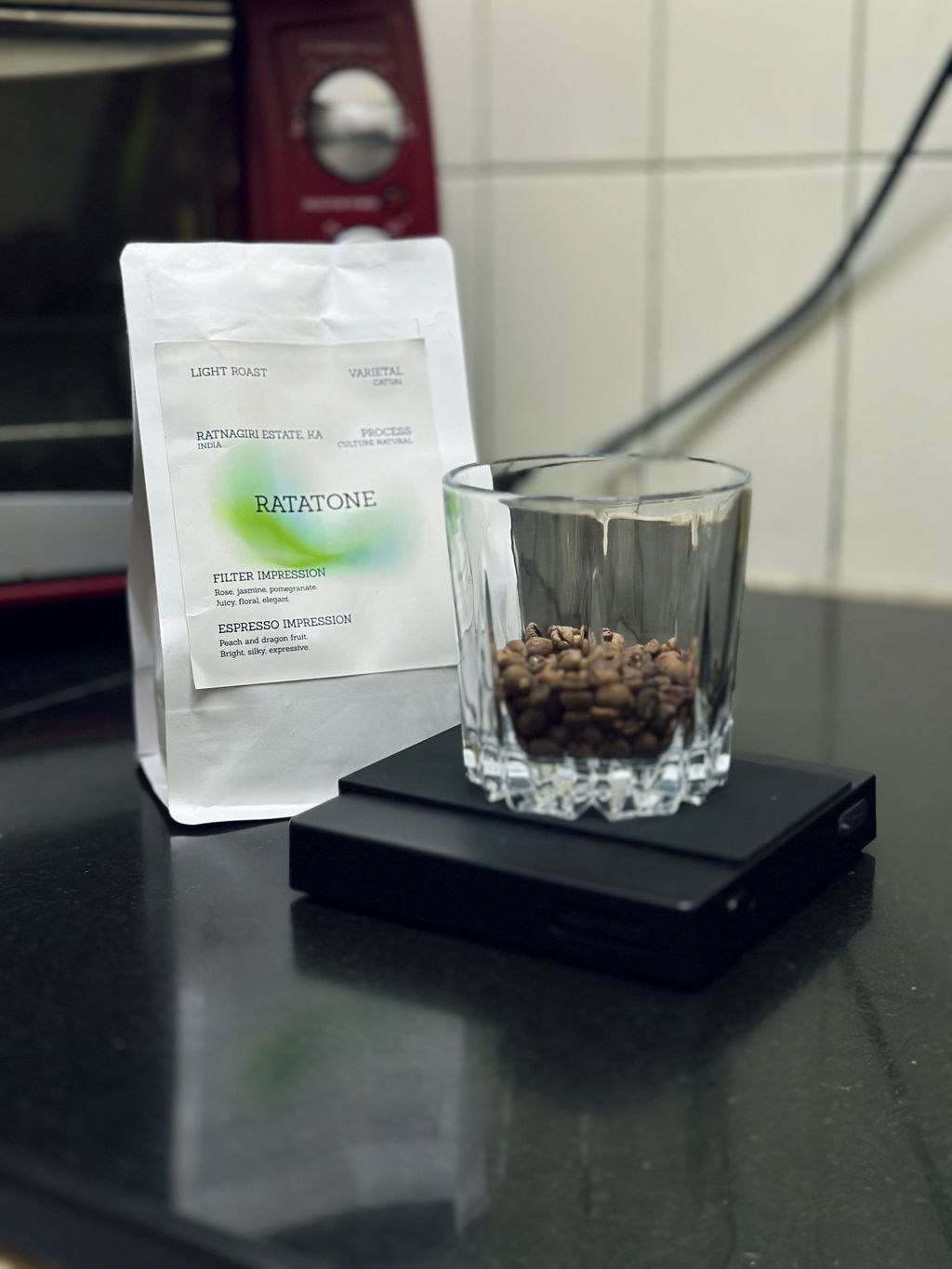
Ratatone

In the cup
In the filter
- Rose
- Jasmine
- Pomegranate
- Peach
As espresso Syrupy · Fruit-forward
Roast depth25 / 100 · Medium light
Best as
- Espresso
- Pour-over
- AeroPress
Pick your grind
Best for this coffee
- Whole bean
- Home espresso machine, Best for this coffee
- Commercial espresso machine, Best for this coffee
- South Indian filter
- AeroPress, Best for this coffee
- Moka pot
- Pour-overV60 · Kalita · Origami, Best for this coffee
- Chemex, Best for this coffee
- French press
- Cold brew
Not sure? Choose Whole Bean, or WhatsApp us your machine: +91 85951 15712
Where it's from
- Origin
- Ratnagiri Estate, Chikmagalur, Karnataka
- Process
- 54-hour lactic culture natural
- Elevation
- 1,310 m
Brew it
Preparation ticketRatatone
Pour-over (V60)
Clean and sweet
- Dose
- 15g
- Water
- 250g
- Water temp
- 93°C
- Time
- 2:45 – 3:15
- Ratio
- 1 : 16
- Grind
- Medium-fine, like sand
- Rinse the paper filter with hot water and empty the cup. Add 15 g coffee.
- Pour 40 g of water and wait 30 seconds so the coffee can puff up.
- Pour in slow circles up to 250 g in total, finishing by 1:30.
- Wait for it to drip through. Swirl and enjoy.
Make this
6 minIced pour-over
Brewed hot straight onto ice. Keeps every bit of the fruit.
- 15 g
- Ratatone, ground medium-fine
- 150 g
- hot water, 92 °C
- 120 g
- ice cubes, in the glass
- Put the ice into a glass or small jug below the dripper.
- Rinse the paper filter and add the coffee.
- Pour 30 g of water and wait 30 seconds.
- Pour the rest slowly in circles. The hot coffee melts the ice and chills itself.
- Swirl and serve.
Why people come back
“SO GOOD! Been brewing it as a pourover and the floral notes really shine!”
5.0 · 4 reviews
- Roasted to order in Delhi
- Dispatched within 48 hours
- Free shipping across India
- First Bag PromiseOne free swap on your first order if it's not to your taste.
RATATONE
- Regular price
- Rs. 1,240.00
- Sale price
- Rs. 1,240.00
- Regular price
- Tastes likeRose, jasmine, pomegranate, peach
- Best forAeroPress · Espresso · Pour-over
- FreshRoasted to order, dispatched in 48 h
Roasted to order, dispatched in 48 h
- Free shipping across India
- First Bag Promise
- Secure checkout
What is the First Bag Promise?
If your first BROOT bag is not to your taste, tell us and we will swap it once, free. One swap per first order.
First order? 10% off with code FIRSTCUP at checkout.
Rose and jasmine over peach and pomegranate, bright without shouting.
Ratatone is a Catuai from Ratnagiri Estate in Chikmagalur, dried whole as a culture natural. Lactic acid bacteria drive the ferment for 54 hours before the cherries go down to dry, and that pushes the sweetness up.
We roast it medium light, to Depth 25, so the roast stays out of the way of the ferment.
It is not a chocolate-and-caramel coffee. Skip it if that is what you want.
- Origin
- Ratnagiri Estate, Chikmagalur, Karnataka
- Variety
- Catuai
- Process
- 54-hour lactic culture natural
- Elevation
- 1,310 m
- Roast
- Medium light
- Depth
- 25 of 100
- Sizes
- 250 g or 1 kg
Where to start
Pour-over
- Dose15 g
- Water250 ml
- Temp93 °C
- Time2:45–3:15
- GrindMedium fine
Which grind should I pick?
Pick the grind named for your brewer when you add the bag to your cart: whole bean, home or commercial espresso, South Indian filter, AeroPress, moka pot, pour-over, Chemex, French press or cold brew. Both bag sizes come in every grind. We grind exactly what you choose and cannot un-grind it, so order whole bean if you are not sure.
How fresh will it be?
Roasted to order at our roastery in Delhi. Most orders leave us within 1–2 working days, up to 4 in a heavy roast week.
How fast will it reach me?
Dispatched within 48 hours. Courier delivery usually takes 2–4 working days to the metros and 4–7 to the rest of India. Shipping is free across India.
Will it taste bitter?
Not usually. It is roasted medium light, Depth 25 on our 0 to 100 scale where 0 is the lightest, so the cup leans to sweetness and fruit rather than roast bitterness. If a cup ever tastes bitter, grind a little coarser or brew a touch cooler. If it tastes flat or sour, grind a little finer.
Is it worth trying on a first order?
If your first BROOT bag is not to your taste, tell us and we will swap it once, free. One swap per first order.
How should I brew it the first time?
Plain, with no milk and no sugar, so you can taste the ferment on its own. It wants hot water, a filter and a few minutes of attention.
Why is the roast so light?
The character comes from the ferment, not the roast. Go darker and the florals are the first thing to go.
Roasted to order in Delhi
Storing it
Seal the bag after every use and keep it somewhere cool, dry and dark. Not the fridge, not the freezer — both move moisture into the beans.
Storing it
Seal the bag after every use and keep it somewhere cool, dry and dark. Not the fridge, not the freezer — both move moisture into the beans.
Grind immediately before you brew, and use filtered water. Ground coffee loses more in an hour than whole bean loses in a week.
Shipping & Returns
Roasted and dispatched within 1–2 working days. Delivery takes 2–4 days to the metros and 4–7 days to the rest of India. Shipping is free.
SO GOOD! Been brewing it as a pourover and the floral notes really shine! 🤩
Flowers you can taste
Perfection…
best coffeee ever, never want to stop drinking it for real 😋🥹😍
great coffee, with nice floral notes


Ledger
- Origin
- Ratnagiri Estate, Chikmagalur, Karnataka
- Process
- 54-hour lactic culture natural
- Varietal
- Catuai
- Elevation
- 1,310 m
- Roast
- Medium light
- Depth
- 25medium light
- Built for
- Filter · AeroPress · espresso
- Sizes
- 250 g · 1 kg
In the cup
02methodsFilter
- Rose
- Jasmine
- Pomegranate
- Peach
Espresso
- Syrupy
- Fruit-forward
-
Where it grows
Ratnagiri Estate is 117 hectares in the Attigundi area of Chikmagalur, on ground that drains off the Baba Budan range. SLN 9 is the backbone of the plots, and Catuai grows alongside it. This lot is Catuai, at 1,310 m. The estate runs more than 15 processing protocols in a season, and this is its 54-hour lactic one.
-
The 54 hours
The cherries are dried whole, as a natural, but first lactic acid bacteria drive a ferment for 54 hours. Then the cherries go down to dry. The lactic route pushes sweetness up and sets florals over the fruit. It is the ferment doing the work here, not the roast.
-
How we roast it
Depth 25, medium light, roasted after you order in Delhi. Because the character comes from the ferment, the roast stays out of its way. Medium light keeps the rose and jasmine legible rather than buried, and the brightness is there without shouting. Go darker and the florals are the first thing to go.
-
Fair warning
It is not a chocolate-and-caramel coffee. If you want something dark and roasty, skip it. It wants hot water, a filter and a few minutes of attention. Brew it plain the first time, with no milk and no sugar, so you can taste the ferment on its own.
Brew it
03ticketsBrewing ticketNo. 01
Filter
- Dose
- 15g
- Water
- 240ml
- Temperature
- 92–94°C
- Time
- 2:45–3:00
Grind · Medium-fine
1:16. Bloom 40 s, then gentle pours.
Brewing ticketNo. 02
Espresso
- Dose
- 18g
- Water
- 41g out
- Temperature
- 94°C
- Time
- 30–33s
Grind · Fine
1:2.3. Syrupy and fruit-forward.
Brewing ticketNo. 03
AeroPress
- Dose
- 14g
- Water
- 220ml
- Temperature
- 92°C
- Time
- 1:30
Grind · Medium
Steep 90 s, press slowly.
Keep it
Seal the bag after every use and keep it somewhere cool, dry and dark. Grind just before you brew. Best within 4–8 weeks after roasting.
Pair it
- Mid-morning, black.
- Plain yoghurt and ripe fruit.
- A butter croissant.
Ask us
05questionsWhat is a culture natural?
A natural is dried with the fruit still on the bean. A culture natural adds a ferment first: here, lactic acid bacteria for 54 hours, then the cherries go down to dry. The lactic route pushes sweetness up and sets florals over the fruit.
Will it taste sour?
It is bright without shouting. Use hot water, 92–94 °C, and aim for 2:45–3:00. If it still tastes sour, grind finer. If it tastes bitter, grind coarser.
Can I make espresso with it?
Yes. Run it at 1:2.3 in 30–33 s, which is about 18 g in and 41 g out. It comes out syrupy and fruit-forward. It is not a chocolate-and-caramel espresso.
How is it different from the Natural Cut?
The Natural Cut is SLN 9, a natural roasted medium to Depth 46: red fruit and jam over a heavy body, with a funky finish. Ratatone is Catuai, a 54-hour culture natural at Depth 25: floral and layered, bright without shouting.
Which grind should I choose?
For a V60, Kalita or Origami choose Pourover/V60/Kalita/Origami. For AeroPress, choose Aeropress. A filter shows the florals best. If you grind at home, Whole Bean keeps longest.
More from Chikmagalur
04on the shelf-
BRUTE FORCE
-
VELVET HARMONY
House blend
Toasted nuts, Mild cocoa, Brown sugar.
Chikmagalur, Karnataka
- Pour-over / filter
- Espresso
- With milk
Best seller.
fromRs. 720.00 -
RATNAGIRI NATURAL CUT
Ratnagiri Estate
Fruity, caramel sweet.
Ratnagiri Estate, Chikmagalur, Karnataka
- Pour-over / filter
- Espresso
fromRs. 920.00 -
HOUSE NO. 02
House Series
Warm cocoa, Brown sugar, A familiar finish.
Chikmagalur · Kaimara, Karnataka
- Pour-over / filter
- Espresso
- Moka pot
fromRs. 820.00


Depth · Shallow
25/100
Shallow ground. Fruit and florals still lead, sugars only beginning.
Where to start · Filter
- Dose15 g
- Water250 g
- Temp93 °C
- Time2:45–3:15
Grind medium. A house baseline for this depth, not a rule for this lot — move one thing at a time.
Beneath before cup.
You may also like
Shopping Bag: 0 Items
Free shipping across India — every order
What are You Looking for?
Account
- Choosing a selection results in a full page refresh.

RATATONE
Whole Bean · 250 GRs. 1,240.00
Welcome to BROOT
10% off your first bag.
Roasted in Delhi after you order, shipped free. Roast drops and brew notes, nothing else. Your code arrives the second you subscribe.
No spam, ever. Unsubscribe in one tap.
You are in
Welcome to the Brew Club.
Here is your code for 10% off your first order. It is also on its way to your inbox.
One use per customer. Applied automatically when you tap the button.