
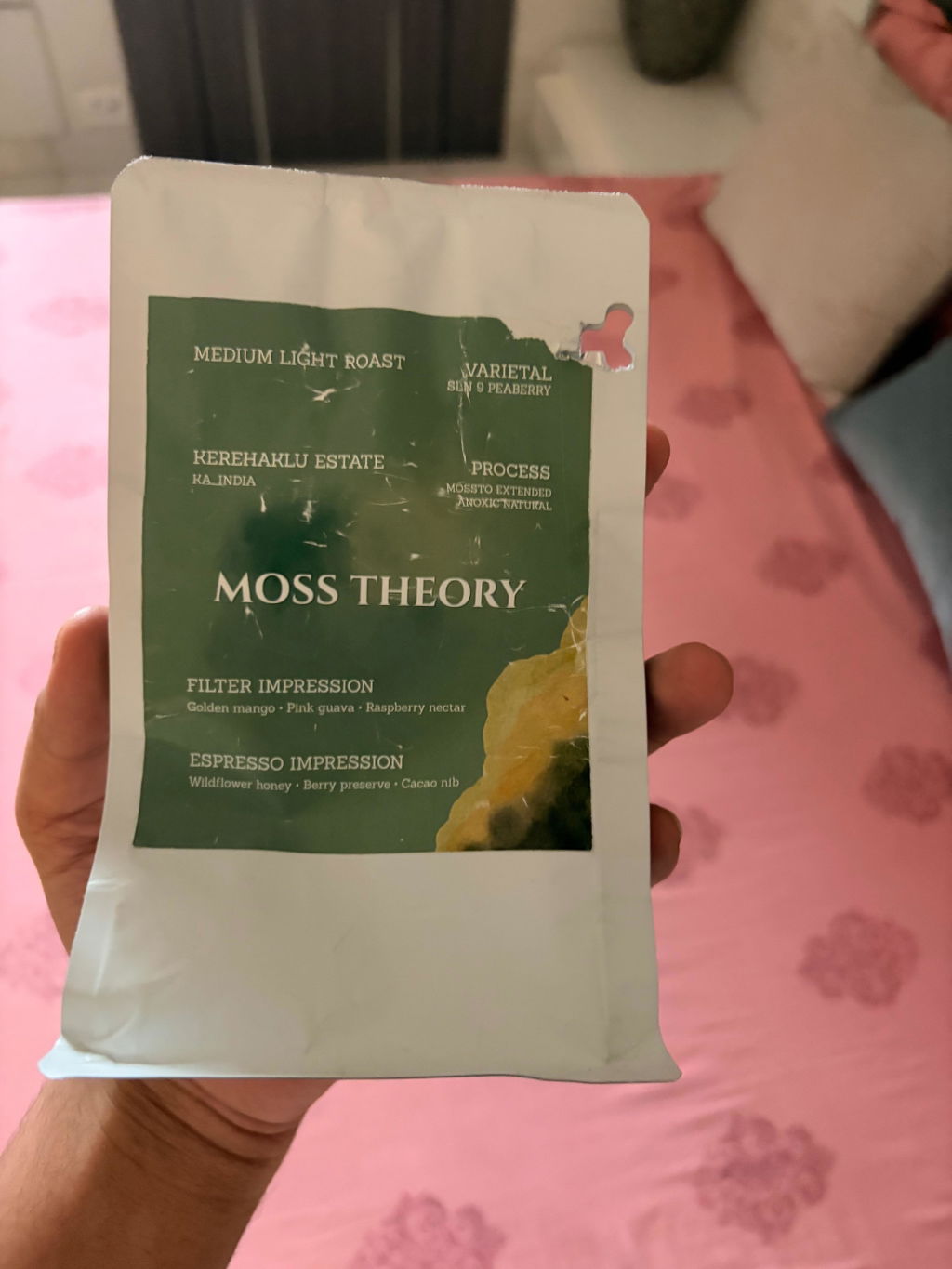
Kerehaklu Estate · Karnataka · extended anoxic natural
Mango first, guava as it cools, raspberry at the close. A peaberry from a long, sealed ferment.
Plate 18. Fruit, built slowly.SLN 9 peaberry · 250 g
MOSS THEORY
- Regular price
- Rs. 1,350.00
- Sale price
- Rs. 1,350.00
- Regular price
First order? 10% off with code FIRSTCUP at checkout. Free shipping across India.
Roasted after you order · dispatched in 48 h · free shipping across India
Moss Theory is a light-roast peaberry from Kerehaklu Estate in Karnataka, given an extended anoxic ferment and dried as a natural. The cup is syrupy and layered, and clean for all that. Golden mango comes first, pink guava opens as it cools, and raspberry closes.
Brew it as pour-over, 15 g to 240 g of water at 92 °C, or pull it as espresso once the bag has rested 12–14 days. We would not put milk on it. The fruit is the point, and milk covers it.
A limited lot, roasted to order in New Delhi.
Storing it
Seal the bag after every use and keep it somewhere cool, dry and dark. Not the fridge, not the freezer — both move moisture into the beans.
Storing it
Seal the bag after every use and keep it somewhere cool, dry and dark. Not the fridge, not the freezer — both move moisture into the beans.
Grind immediately before you brew, and use filtered water. Ground coffee loses more in an hour than whole bean loses in a week.
Shipping & Returns
Roasted and dispatched within 1–2 working days. Delivery across India usually takes 3–6 days depending on where you are.
Shipping is free across India, on every order.
Shipping & Returns
Roasted and dispatched within 1–2 working days. Delivery across India usually takes 3–6 days depending on where you are.
Shipping is free across India, on every order.
Something i haven’t experienced before. Its a must have. Try to make it in a v60 and youll be surprised


Ledger
- Origin
- Kerehaklu Estate, Karnataka
- Grower
- Pranoy Thipaiah
- Elevation
- 1,100–1,200 m
- Varietal
- SLN 9 peaberry
- Process
- Mossto extended anoxic natural
- Roast
- Light
- Depth
- 18light
- Built for
- Pour-over · espresso
- Size
- 250 g
In the cup
02methodsFilter
- Golden mango
- Pink guava
- Raspberry nectar
Espresso
- Wildflower honey
- Berry preserve
- Cacao nib
-
Where it grows
Kerehaklu Estate sits at 1,100–1,200 m in Karnataka, and Pranoy Thipaiah grows the coffee. This lot is SLN 9 peaberry: one round bean in the cherry where there are usually two. Cultured 42 comes from the same estate. Same grower, same altitude band, a very different cup. Taste the two side by side.
-
How it is fermented
A Mossto extended anoxic natural: a long ferment sealed away from air, on coffee that is dried in the fruit. Done slowly and sealed, it builds fruit without muddying it. The cup is syrupy and layered, and it still reads clean.
-
How we roast it
Roasted light, to Depth 18, the lightest band on our scale. A deeper roast would cover the ferment, so we stop early. Mango leads the first sip, guava opens as the cup cools and raspberry closes it. Let the bag rest a few days after roasting before you brew. The fruit needs the time to open.
Brew it
02ticketsBrewing ticketNo. 01
Pour-over
- Dose
- 15g
- Water
- 240g
- Temperature
- 92°C
- Time
- 2:45–3:00
Grind · Medium-coarse
Let the cup cool a little. The guava opens as it does.
Brewing ticketNo. 02
Espresso
- Dose
- 18g
- Water
- 40g out
- Temperature
- 93°C
- Time
- 28–32s
Grind · Fine
Deeper and sweeter than the filter, with cacao nib in the finish. Rest the bag 12–14 days first.
Keep it
Seal the bag after every use and keep it cool, dry and dark. Not the fridge. Grind just before you brew. The fruit is brightest in the first few weeks after the roast.
Pair it
- Black, no sugar.
- Plain yoghurt and fruit.
- A square of white chocolate.
Ask us
05questionsWhat is a peaberry?
Most cherries hold two flat-sided beans. In a peaberry, one round bean grows instead. Moss Theory is a peaberry lot, so the beans in the bag are the round single ones.
Does it work with milk?
We would not. It is a light roast built around fruit, and milk covers the mango and guava. Try it black first. For milk, take a darker roast such as Dark Matter.
How fresh is it, and when should I brew it?
Roasted to order in New Delhi and dispatched within 1–2 working days. Courier transit is usually 2–4 working days to the metros, 4–7 elsewhere in India. Shipping is free. Filter wants a few days off the roast, espresso 12–14.
Which grind should I choose?
Pour-over, or espresso if you have a machine. They are the two it is roasted for. At checkout you can also pick whole bean, home or commercial espresso, South Indian filter, AeroPress, moka pot, pour-over, Chemex, French press or cold brew. Whole bean keeps longest.
Moss Theory or Cultured 42?
Both come from Kerehaklu. Cultured 42 is washed and clean: green apple, lime zest. Moss Theory is a natural and the fermentation shows: mango, guava, raspberry. Take Cultured 42 for clarity, Moss Theory for fruit.
More fermented coffees
04on the shelf


Depth · Surface
18/100
Right at the surface. Acid-forward and tea-like — built for filter.
Where to start · Filter
- Dose15 g
- Water250 g
- Temp94 °C
- Time2:45–3:15
Grind medium-coarse. A house baseline for this depth, not a rule for this lot — move one thing at a time.
Beneath before cup.
You may also like
Shopping Bag: 0 Items
Free shipping across India — every order
What are You Looking for?
Account
- Choosing a selection results in a full page refresh.

MOSS THEORY
Whole Bean · 250 GRs. 1,350.00
Welcome to BROOT
10% off your first bag.
Roasted in Delhi, shipped fresh. Join the Brew Club for roast drops, brew notes and first access. Your code arrives the second you subscribe.
No spam, ever. Unsubscribe in one tap.
You are in
Welcome to the Brew Club.
Here is your code for 10% off your first order. It is also on its way to your inbox.
One use per customer. Applied automatically when you tap the button.